Turn Historical Questions Into Memorable Play
The most enjoyable history lessons give children something meaningful to do: solve a mystery, test an old design, interview a witness, decode an object, or decide how to arrange evidence. Fun does not require turning the past into fantasy or rewarding children for racing through facts. It comes from agency, surprise, movement, and the satisfaction of making a supported discovery. A kitchen, sidewalk, library, or cardboard box can become a useful learning space when the activity begins with a real historical question. Children who resist a long explanation may happily study the same period when they need its details to complete a challenge, and children who love books gain a reason to use what they read. The ideas below are flexible enough for family learning, classrooms, and mixed-age groups. Each one combines play with context, so children leave with more than a craft or a fleeting afternoon memory. They practice observing, sequencing, comparing, explaining, collaborating, and noticing that people in the past faced choices rather than following a script written in advance.
A: No. Play can support careful evidence work when the activity has a real question, accurate context, and reflection.
A: Many investigations work in twenty to forty minutes, while walks, interviews, and exhibitions benefit from several shorter sessions.
A: Use caution. Role-play decisions or practical tasks without asking children to simulate oppression, sacred identities, or another person's trauma.
A: Treat the guess as a hypothesis, return to the evidence, and celebrate the revision rather than rewarding confidence alone.
A: They are useful when materials, constraints, makers, and purpose are researched; a decorative project without context teaches little history.
A: Give younger learners observation and sorting roles while older learners investigate provenance, context, and competing explanations.
A: No. Replicas, ordinary family objects, digitized collections, maps, and photographs provide abundant evidence without risking valuable items.
A: Pause calmly, name the inaccurate generalization, offer specific evidence, and redirect the activity toward real people and variation.
A: A little advance context and a focused object hunt make the visit far more meaningful than trying to absorb every gallery.
A: Listen for accurate sequence, source-based explanations, recognition of perspective, and willingness to revise a claim.
Set Up a Mystery Table
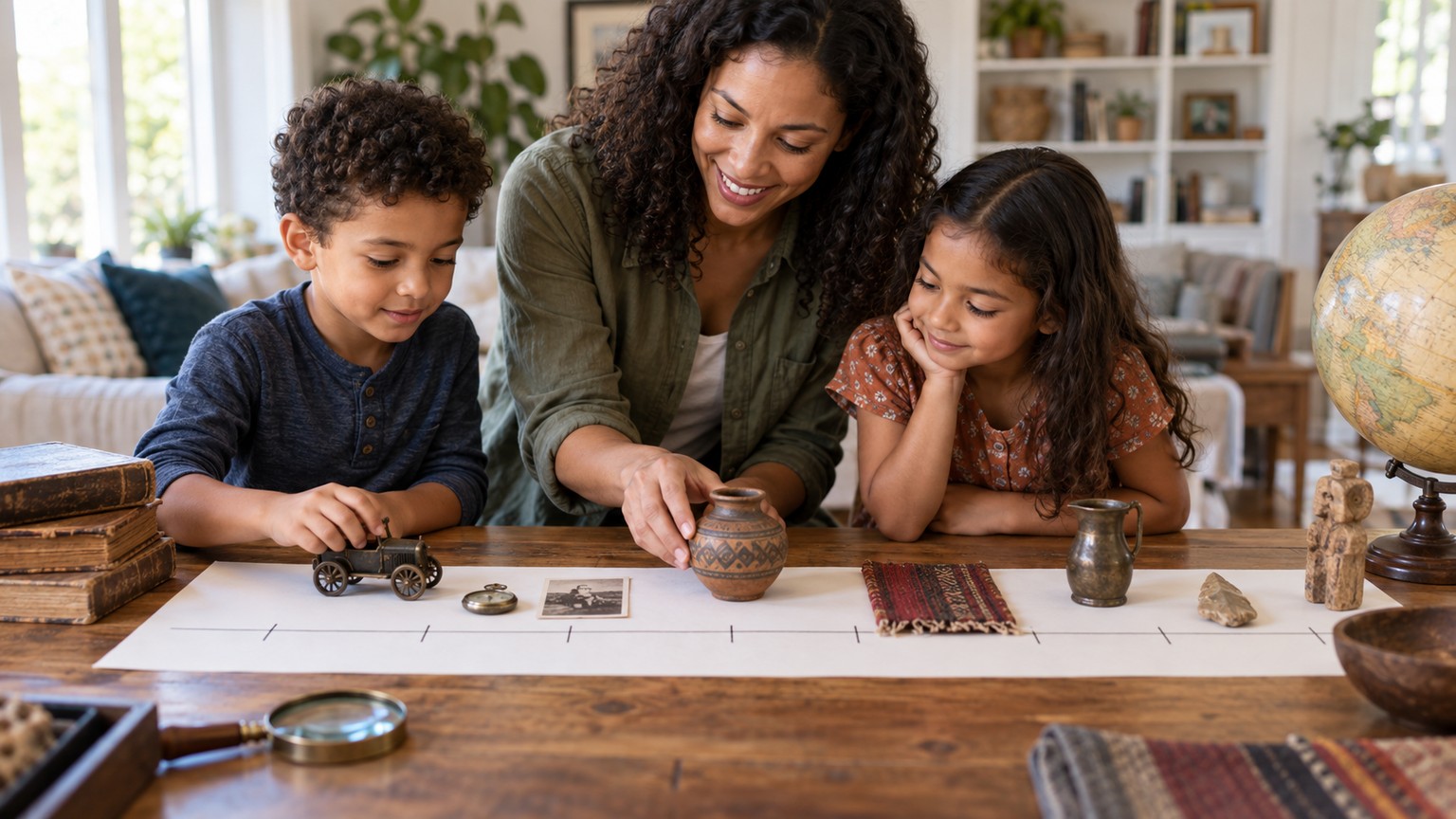
Gather four or five safe items connected to one theme, such as laundry, lighting, writing, travel, or food storage. Include replicas, modern objects, and printed museum photographs rather than valuable antiques. Cover the labels and invite children to inspect materials, moving parts, wear, weight, and shape. Their task is to group the objects, propose an order, and explain what problem each one solved. Ask each investigator to place a token beside the clue that most influenced their answer. The tokens make reasoning visible and often show that children reached the same conclusion by different routes. Introduce one misleading resemblance, such as a modern object styled to look old, so age is not judged by color alone. A magnifier, scale, flashlight, and measuring tape can turn the table into a laboratory, but tools should answer a question rather than become distractions. Only after the evidence discussion should the adult reveal dates and names. Read the museum description aloud, including any uncertainty about the maker or use, and compare it with the group's claims. Children can award a point to evidence that survived the reveal, not to the person who guessed the label first. A mystery table works because the child has a reason to care about the information that follows. Keep one object unresolved and research it together, demonstrating that a good investigator can change direction. Save the observation notes for a later mystery; improved noticing becomes obvious when learners compare their early descriptions with newer ones.
Walk Through a Changing Neighborhood
Choose a short route with an older building, a renamed business, a transit stop, a park, or a visible change in land use. Find two or three historic images before the walk and print them without lengthy captions. At each location, let children line up the old view with the present scene. They can hunt for a roofline, tree, curb, window, or hill that survived. Ask what changed slowly, what appears to have changed quickly, and which clues are hidden from a photograph, including sound, smell, movement, and who felt welcome there.
Back home, make a layered map. Use one color for features that remained, another for additions, and removable notes for questions. Avoid describing every older building as better or every new one as progress. A factory may have provided wages and polluted a stream; a highway may have shortened some journeys while dividing a neighborhood. Even young children can hold two effects at once when examples are concrete. A final drawing of one location in the past, present, and imagined future turns observation into a conversation about stewardship.
Reconstruct an Everyday Solution
History is full of practical engineering. Challenge children to keep a pretend message dry, carry water without spilling, store a fragile object, illuminate a small space safely, or move a load using only materials available in a chosen period. Establish the place, time, resources, and safety rules first. A child investigating a clay storage vessel should know whether the community had access to metal, wheels, local reeds, or fired pottery. Constraints transform random building into historical reasoning.
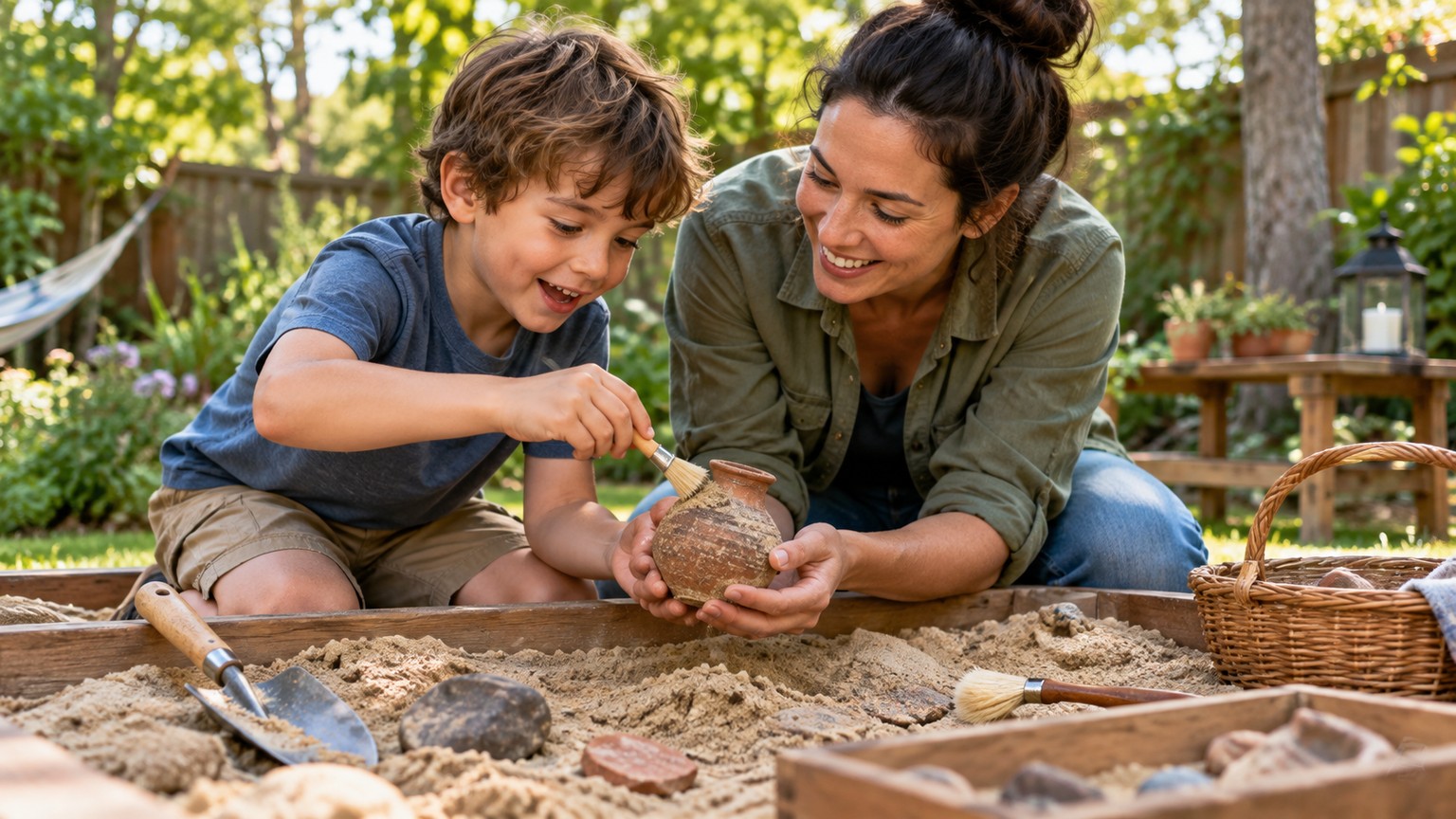
Let the first design fail in a useful way. A paper container may sag, a knot may loosen, or a model bridge may twist. Document the result, then compare it with an artifact or diagram from a reliable collection. Ask what the historical maker understood about force, weather, heat, or available materials. Children can revise their design, but they should not claim to have recreated an entire technology from one attempt. The lesson is respect for accumulated knowledge, not the idea that modern learners are rescuing the past from simplicity.
Finish with a maker's explanation. The child names the problem, points to evidence that influenced the design, and identifies one feature still uncertain. This brief reflection separates a history-engineering lesson from an ordinary craft. It also gives verbal learners, builders, and careful observers different ways to contribute. Photograph the stages rather than only the polished final model, because the sequence shows how evidence changed the thinking.
Stage a Source Relay
Place different sources around the room: a map, an object photograph, a short quotation read by an adult, a census-style table simplified for age, and a piece of music. Teams visit one station at a time and add a single observation or question without erasing earlier notes. The challenge is not speed. It is to contribute something new and distinguish what the source directly shows from what a learner infers. When everyone gathers, combine the clues into a provisional account and identify which source changed the group's first idea most strongly.
Make a Human Timeline
Give each participant an event card from a focused story, perhaps the development of a local park, the journey of a food, or changes in children's books. Children arrange themselves in order and explain the connection between neighboring cards. Add blank cards for long stretches when little recorded change occurred, and overlap cards when events happened at the same time. The physical spacing makes duration visible. It also exposes the false assumption that one invention immediately reached everyone.
Introduce a surprise card after the first arrangement: a drought, new law, migration, scientific discovery, price change, or community protest. Ask where it belongs and which later events it may have influenced. Children may need to rearrange themselves and revise their explanation. That movement models historical interpretation: new evidence can change a sequence or reveal a relationship that was previously invisible. Keep causation cautious. Replace 'this caused everything' with language about contribution, pressure, opportunity, and consequence.
Turn Oral History Into a Listening Game
With permission, invite a relative or community member to describe one narrow experience, such as their route to school, a neighborhood celebration, a first job, or a household chore. Children prepare open prompts and predict which sensory details might appear. During the conversation, they listen for a place, object, sound, feeling, and change. They should not interrupt to complete the speaker's sentences or demand private memories. An adult can model a gentle follow-up: 'What happened next?' or 'How did you learn to do that?'
Afterward, separate memory from verification without dismissing the narrator. A person is the authority on their experience, but a date, building name, or broader claim may be checked in a newspaper archive, map, or photograph. Compare what the formal record preserves with what the conversation reveals. Official sources might list a school opening while the speaker remembers the muddy shortcut children took each morning. Together, those accounts produce a fuller picture.
Create a thank-you artifact for the participant. A child might assemble a one-page memory map, an audio clip with consent, or a small illustrated booklet. Share it with the narrator before showing anyone else and accept corrections. This teaches ethical history: stories are not raw material to take without care. The relationship with the person who shared them matters as much as the finished project.
Use Food as Evidence, Not a Costume
A recipe can reveal trade routes, climate, technology, migration, religious practice, class, and adaptation. Select one dish with a trustworthy source and trace two ingredients. Which are local to the region? Which arrived through trade, conquest, forced labor, or migration? How did grinding, preservation, fuel, or refrigeration affect preparation? If cooking is possible, compare texture and process rather than judging whether a food seems strange. If it is not, examine utensils, market photographs, oral accounts, and contemporary cooks who explain what the dish means in their own lives.
Let Children Curate the Ending
Close a sequence of lessons by making a tiny exhibition instead of giving only a worksheet. Children select three to six items from their work and decide the order in which a visitor should encounter them. Each label must state what the evidence shows, where it came from, and one question it cannot answer. Include a hands-on replica or listening station when possible, but protect original materials and private family information. A curator has responsibilities, and children rise to that role when the audience is real.
Invite visitors to leave questions rather than scores. The young curators can choose one question to investigate and update a label afterward. This final revision keeps history alive instead of presenting the display as a perfect conclusion. It also makes assessment natural: an adult can hear whether a child understands chronology, context, evidence, and perspective while the child explains choices. The most successful lesson ends with a stronger question and a desire to keep looking.
Keep the Fun Grounded in Real People
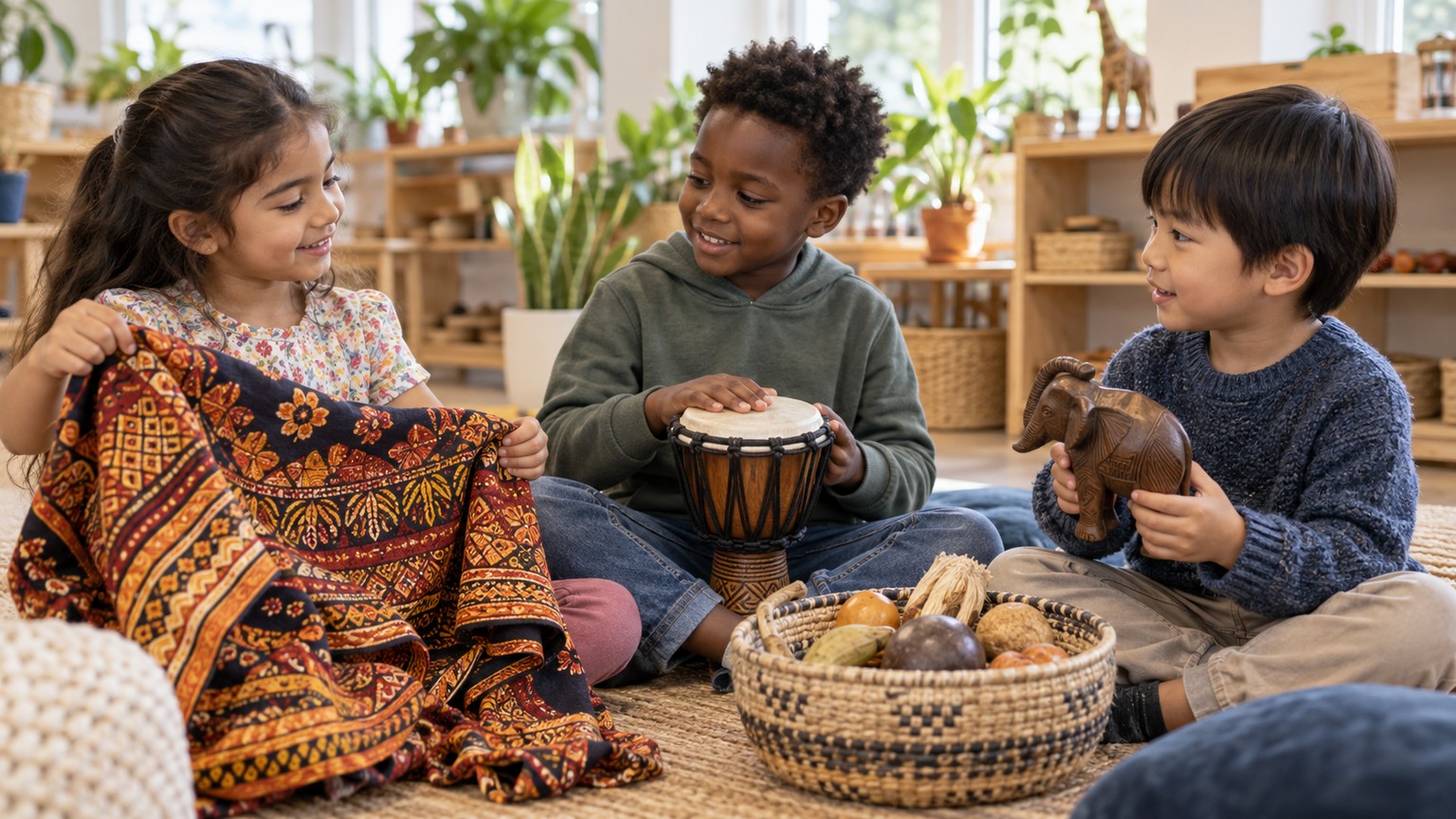
An activity can be lively and still mislead if it strips away names, locations, or historical conditions. Before inviting children to build, cook, move, or perform, establish whose experience is being studied and what evidence supports the setup. Replace broad themes such as 'ancient people' with a particular community and period. Explain whether the material is an authentic source, a modern replica, or a classroom substitute. Those distinctions do not burden the game. They give choices meaning and prevent children from leaving with a colorful but inaccurate composite of unrelated cultures.
Avoid competitions that make conquest, escape from oppression, scarcity, or forced migration into entertainment. Children should never earn points by taking land, trading people, or surviving someone else's trauma. The same historical topic can be explored through ethical choices: analyze a law, compare testimony, map access to resources, examine resistance, or curate voices excluded from an official account. For difficult material, preview emotional demands and provide a way to step back. Enjoyment can come from inquiry and collaboration rather than pretending that every human experience is suitable for simulation.
Accuracy also includes admitting the limits of a short lesson. A thirty-minute mystery cannot represent an entire civilization, and one oral history cannot stand for a neighborhood. End by naming the narrow claim children can support and the larger questions still open. Offer a book, collection, local site, or first-person source that continues the thread. When children learn to enjoy investigation rather than a tidy performance, they develop the patience history needs. They can laugh, move, invent, and build while still treating the people they study as complex human beings rather than characters arranged for a game.
Carry One Discovery Forward
Let the next lesson begin with a clue saved from the last one. Children can revise an exhibit label, test an unanswered design problem, or locate a missing voice. Continuity gives playful learning depth and rewards curiosity that lasts beyond the activity.