Helping Children Understand Culture Without Stereotypes
Culture is the shared, changing knowledge people use to live together: languages, values, art, food, work, stories, celebrations, beliefs, manners, technologies, and countless everyday choices. No child or family contains an entire culture, and no country has only one. Young learners can understand this complexity when adults begin with concrete life rather than sweeping labels. A greeting, lunchbox, lullaby, apartment building, market, game, or family rule offers a manageable window into how people learn from one another and adapt to place and time. The purpose is not to collect colorful facts about distant groups. It is to help children become attentive neighbors who recognize both common human needs and meaningful differences. That requires specific language, contemporary voices, honest history, and room for individuals to describe themselves.
A: Yes, when the lesson includes makers, ingredients, labor, history, variation, and contemporary family life rather than stopping at a taste test.
A: Usually avoid copying identity-based or sacred clothing; study design, materials, context, and named creators instead.
A: Name the overgeneralization calmly, supply specific counterevidence, and offer several voices from the community.
A: A guest can share personal knowledge, but should not be expected to represent everyone or answer questions beyond their experience.
A: Allow preference without ridicule and encourage neutral sensory language rather than insulting the dish or its community.
A: Focus on permission, meaning, credit, fairness, and the difference between learning from someone and taking from them.
A: They help with civic identity and history, but reveal little about the diverse daily lives inside a country.
A: Look for named creators, specific place and date, community connection, clear purpose, and evidence that can be compared.
A: As a valuable and common human ability shaped by family, migration, education, work, and choice.
A: Every community is internally diverse, culture changes, and respectful curiosity begins by listening to how people describe themselves.
Start With What Culture Does
Ask children how a new person learns to participate in a family or classroom. Someone explains where shoes go, when people eat, how turns work, which jokes are funny, and what happens on special days. Much of that knowledge is never written down. Culture works similarly on a larger and more varied scale. People learn patterns from relatives, friends, schools, religious communities, media, neighborhoods, and workplaces. They also question, combine, and change those patterns. Describing culture as learned and shared keeps children from treating it as something carried in a person's appearance.
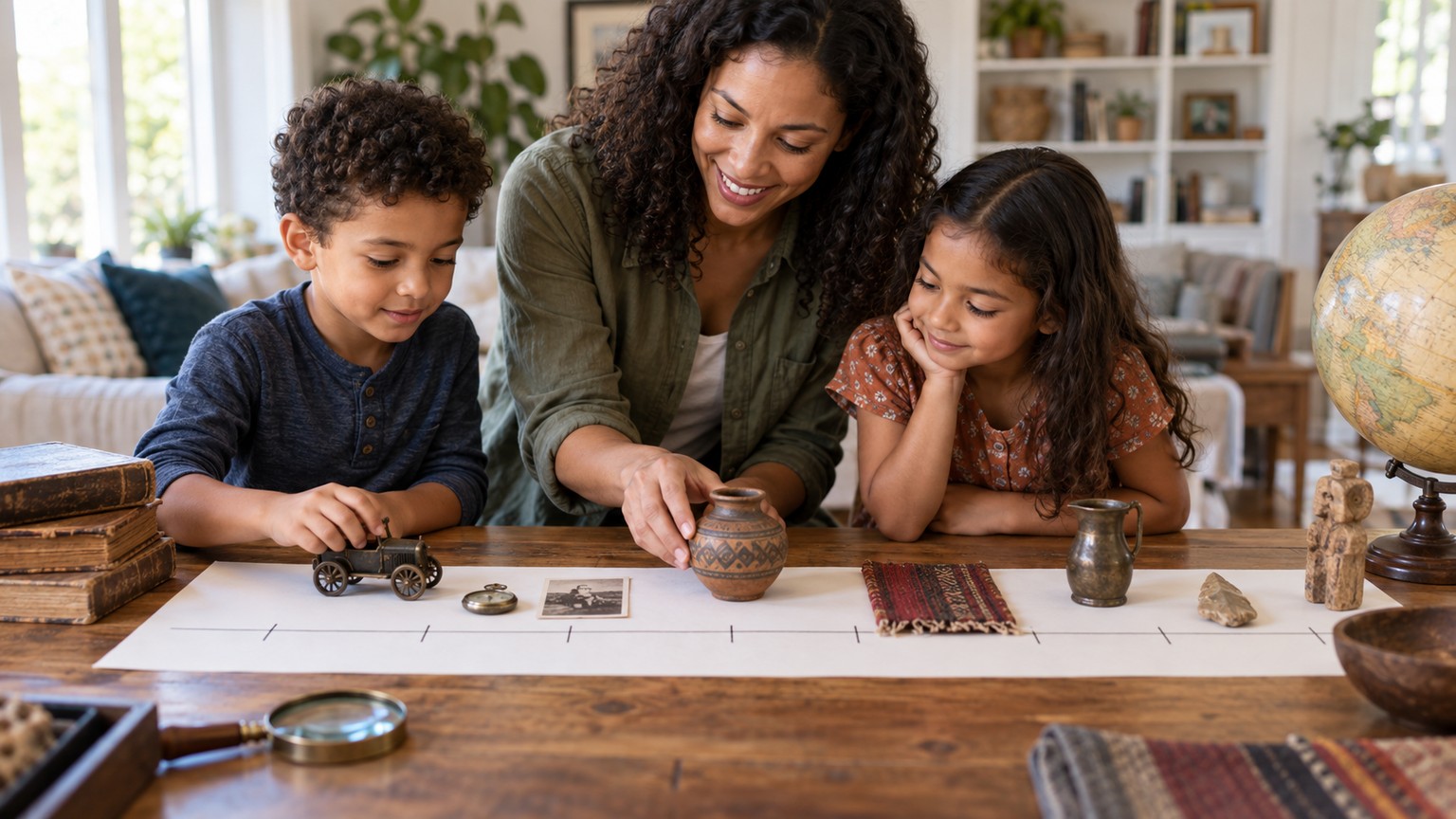
Use familiar examples to show that one person belongs to several groups at once. A child may use one language with grandparents and another at school, follow a regional sports tradition, participate in a faith community, and share online interests with friends elsewhere. None of those memberships erases the others. Draw overlapping circles or arrange objects that represent different parts of daily life. The picture should remain open for change because interests, skills, and relationships grow. This approach makes identity personal without asking a child to disclose information they prefer to keep private.
Replace Country Reports With Focused Questions
A report titled only with a country's name encourages lists of flags, foods, clothing, and landmarks. Narrow questions produce better learning: How do children travel to school in one city? How has a coastal community designed homes for weather? What languages can be heard in a particular market? How do three families prepare for the same holiday differently? A focused question makes room for evidence and prevents one photograph from standing for millions of lives. Locate the place on a map, but also identify region, city or rural setting, period, and the source creator.
Explore Daily Life in the Present Tense
Children often encounter Indigenous peoples and non-Western societies only in historical scenes. Balance historical context with contemporary life. Show architects, farmers, musicians, nurses, athletes, programmers, artists, and children living now. A traditional weaving practice may coexist with digital design; a heritage language may be used in radio, texting, and school. Present-day images resist the notion that cultural authenticity requires living exactly as ancestors did. Traditions remain meaningful partly because people decide how to carry them forward.
Choose sources that name individuals and let them speak. Short interviews, museum programs created with communities, picture books by insiders, and videos from cultural organizations are stronger than anonymous travel montages. Discuss who made the source and what part of life it shows. A wedding video cannot explain an ordinary weekday, and a tourist district cannot represent a whole city. Several modest sources, compared carefully, offer a more honest view than one spectacular image.
Notice similarities without rushing to declare that everyone is the same. Children everywhere need care, communication, belonging, food, and opportunities to learn, but communities meet those needs in varied conditions. Ask how a practice works and what values or circumstances shape it. Then notice variation within the community. Respect grows when difference is neither feared nor flattened.
Talk About Language With Curiosity
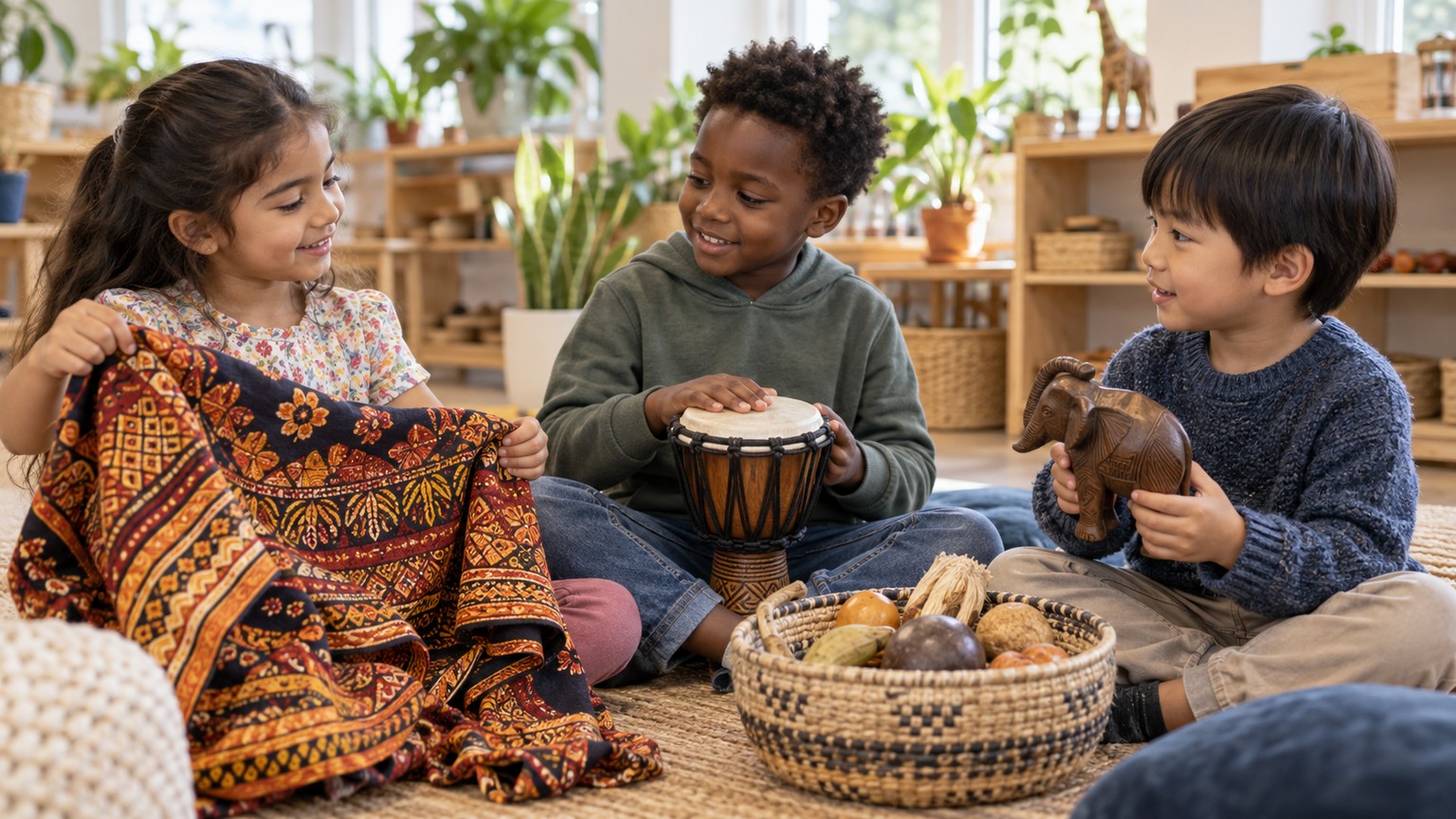
Languages carry humor, history, family relationships, and ways of organizing experience. Play recordings by named speakers, learn a greeting with attention to pronunciation and context, and discuss when formal or informal speech is appropriate. Avoid asking a multilingual child to perform on demand or translate for the group. Instead, invite everyone to notice languages in signs, music, packaging, and family life. Explain that accents show experience and connection; they are not evidence that a speaker is less intelligent.
Put Food in Its Full Story
Food lessons can be rich when they move beyond tasting. Trace where an ingredient grows, who cultivated it, how it traveled, and how families adapted a recipe to new climates or available foods. Discuss labor, preservation, utensils, meal timing, and the people who usually cook. Name the specific dish and community rather than calling it merely ethnic food. If children taste something, model descriptive language about texture, aroma, temperature, and ingredients instead of labeling an unfamiliar food weird.
Remember that no dish represents every member of a nation or heritage. Family recipes differ, dietary practices change, and restaurant versions respond to local customers. A child connected to the culture may never have eaten the selected dish. Present food as one source among many, alongside contemporary stories, homes, work, art, and personal voices. This keeps a pleasant activity from reducing people to what others consume.
Explain Celebrations Through Meaning and Variation
Before making decorations, establish who observes the occasion, what it remembers or expresses, and whether it is religious, civic, seasonal, familial, or several at once. Show how preparation, gathering, music, food, service, prayer, gift giving, or public events may differ by family and location. Avoid staging sacred rituals as classroom play. Children can examine objects, hear a participant explain the tradition, compare calendars, or create a response about a value such as gratitude without pretending to hold an identity that is not theirs.
Calendar lessons should include ordinary time too. If a group appears only on a festival day, children may imagine its members spend life in ceremonial clothing. Pair celebration sources with a school morning, workplace, sports practice, grocery trip, or family evening. Likewise, explain that people may celebrate more than one tradition, observe quietly, reinterpret customs, or not participate at all. Identity never obligates an individual to follow a textbook description.
When families share traditions with a class, make participation voluntary and provide guidance about scope. Ask what they would like others to understand, how materials should be handled, and what may be photographed. Thank contributors without treating them as representatives elected to answer every question about a broad group. A respectful invitation gives control to the people sharing knowledge.
Address Power, Migration, and Cultural Change
Cultural exchange is not always equal. Ideas and objects travel through friendship, trade, migration, tourism, conquest, enslavement, colonization, and mass media. Children can begin by asking who had a choice, who received credit, and who benefited. Explain appropriation in concrete terms: using something meaningful from another community without understanding, permission, or respect can cause harm, especially when members of that community were punished for the same practice. Appreciation involves learning context, listening to community voices, naming sources, and accepting boundaries. Migration shows culture in motion. Families carry languages, recipes, memories, skills, and beliefs while adapting to new laws, neighbors, weather, and resources. Some changes are chosen; others respond to pressure or exclusion. Use first-person stories that preserve agency rather than portraying migrants only as victims or heroes. A suitcase activity can focus on decisions and evidence, but never assume every family kept the same objects or felt the same way about leaving. Discuss cultural change without dividing practices into pure originals and damaged modern versions. Communities have always borrowed, invented, debated, and renewed. The important questions concern relationship, power, attribution, and meaning. Children can learn that respectful participation starts with humility: enjoy what is openly shared, do not copy restricted or sacred forms, credit creators, and remain willing to be corrected.
Build Habits of Respectful Comparison
Comparison works best when the categories are fair. Compare two ways of greeting, building for climate, teaching children, marking a life event, or telling a moral story. Do not compare one community's idealized ceremony with another's ordinary inconvenience. Use parallel sources from similar periods and purposes. Ask what each practice accomplishes, which values it expresses, and how individuals vary. Children may notice a preference, but guide them away from ranking whole peoples as advanced, strange, simple, or exotic.
End with self-reflection and action. Which assumption changed? Which source came from a person within the community? What word became more precise? A child can practice saying a classmate's name correctly, challenge a stereotype in a book, ask before touching a meaningful object, or look for the creator behind an artwork. World-culture learning succeeds when curiosity becomes considerate behavior. The knowledge will always remain incomplete, but the learner knows how to approach another person's life with attention rather than entitlement.
Choose Resources That Widen the View
Build a small source set rather than relying on a single all-purpose book. One contemporary picture book can show a child's perspective, a map can establish location, a short interview can add a first-person voice, and a museum object can connect the present to history. Check publication dates because neighborhoods, borders, terminology, and daily technology change. Look at the creators' backgrounds and source notes without assuming identity alone guarantees accuracy. Strong resources are specific about what they know, transparent about where information came from, and modest about the range of experience they represent.
Libraries and cultural organizations can help families move beyond search results designed for tourism or entertainment. Ask a librarian for books by authors and illustrators connected to the community. Look for exhibits developed in partnership with culture bearers, tribal nations, local historians, or language groups. When a resource contains an outdated label, research the term currently preferred by people it names. Explain to children that respectful language can change as people gain power to describe themselves publicly. Updating a word is not erasing history; it is part of listening more carefully.
Review images as closely as written claims. Are people named, or presented as anonymous examples? Does the collection show many ages, jobs, homes, and personalities, or only ceremony and hardship? Are photographs recent enough for the lesson being taught? Put an appealing image aside when its origin cannot be traced. Children notice which sources adults trust, so source selection quietly teaches ethics. A modest photograph with a clear creator, date, place, and caption often supports richer learning than a dramatic picture detached from context.
Keep a record of what the child studies across a year. A simple list may reveal that some regions appear repeatedly while others are absent, or that certain communities are encountered only through ancient history, conflict, or holidays. Adjust the next choices to widen genres and experiences rather than racing through a checklist of countries. Return to places as well. A second visit through a different person's story teaches more than a shallow tour of another location. Familiarity makes it possible to notice disagreement, generational change, regional identity, humor, and ordinary preferences. No reading plan can cover the world, but it can avoid implying that a few dominant cultures are universal while everyone else is an occasional special topic. Thoughtful selection gives children a lasting expectation: every community contains many voices, and every source opens only one part of the view.
Make Respect Visible
Children remember how adults behave around unfamiliar names, foods, languages, and beliefs. Pronounce carefully, ask before handling meaningful objects, and correct mistakes without defensiveness. Those ordinary actions give every cultural lesson a credible foundation.