Helping Children Meet the Past and the Wider World
History becomes meaningful to children when it feels less like a distant list of rulers and dates and more like an investigation into real lives. A cooking pot, a family photograph, a street name, or a traditional song can open questions about how people solved problems, celebrated, traveled, worked, and cared for one another. World cultures add another vital perspective: there are many thoughtful ways to build a home, mark a season, tell a story, or welcome a guest. Children also discover that communities influence one another through travel, trade, migration, friendship, conflict, and shared ideas, so no culture can be understood as a sealed display case. Parents and educators do not need to know every answer before beginning. They need reliable sources, respectful language, a willingness to notice whose voice is missing, and activities that let children compare evidence without ranking people. With that foundation, history and culture become a continuing conversation about change, connection, ingenuity, belonging, and responsibility.
A: Even preschoolers can work with before and after, family memories, old objects, and stories connected to a specific time and place.
A: A few anchor dates can clarify sequence, but relationships among events, evidence, and change deserve more attention than long date lists.
A: Say so openly, write down the question, and let the child help choose a trustworthy place to investigate.
A: Be specific about region and community, use several contemporary voices, and describe variation within the group.
A: Dress-up can easily flatten sacred or identity-based clothing; focus instead on maker knowledge, materials, purpose, and first-person explanation.
A: Use plain age-appropriate facts, include people who resisted or helped, answer the question asked, and maintain a sense of present safety.
A: It is valuable for perspective and discussion when children know which details are documented and which scenes the author imagined.
A: Look for collection records, named curators or institutions, dates, provenance, source notes, and transparent corrections.
A: Compare what each person could know, seek independent evidence, and accept that some parts may remain unresolved.
A: Children should leave better able to ask where a claim came from, understand context, recognize human complexity, and revise ideas when evidence changes.
Begin With the Child's Own Place in Time
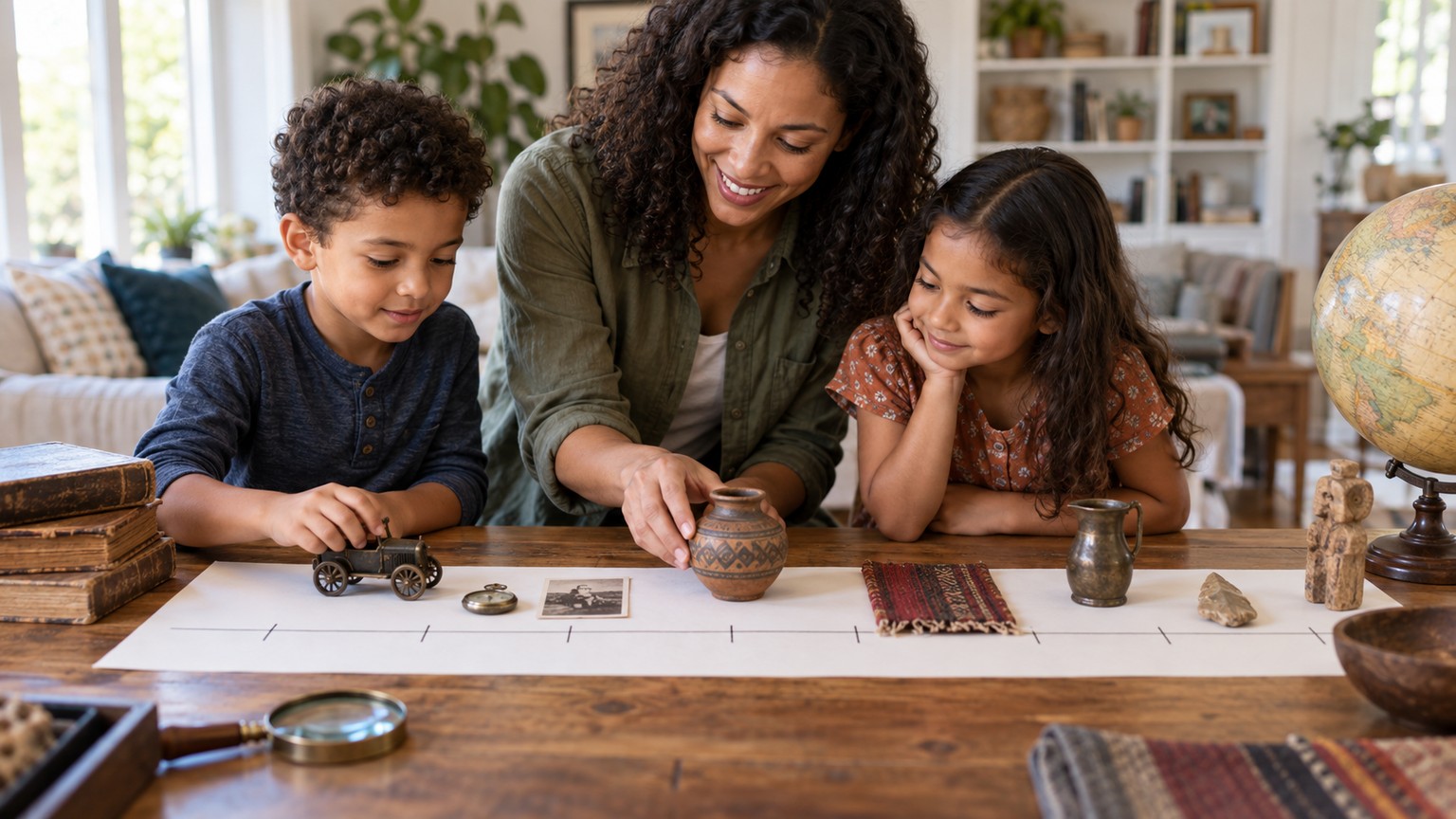
Young learners understand long stretches of time by attaching them to relationships they can picture. Start with today, then move backward through a child's own life, the lives of parents or caregivers, and the childhoods of grandparents or older community members. A short family timeline might include moving to a new home, beginning school, welcoming a sibling, or learning a treasured recipe. These events do not need to be dramatic. Their value lies in showing that the past is made of ordinary days as well as famous turning points, and that every source preserves only part of what happened.
Personal history also introduces evidence gently. Compare a photograph with someone's memory of the same occasion. Look at an old object and ask what its scratches, materials, and size suggest about how it was used. Children soon discover that sources can agree, add different details, or leave questions unanswered. Keep family structures flexible and private: a child may build a timeline around their own milestones, a neighborhood, a pet, or a familiar institution instead of relatives. The goal is orientation in time, not disclosure. Once children can think in terms of before, after, change, and continuity, larger historical stories have somewhere to land.
Treat Objects as Clues Rather Than Decorations
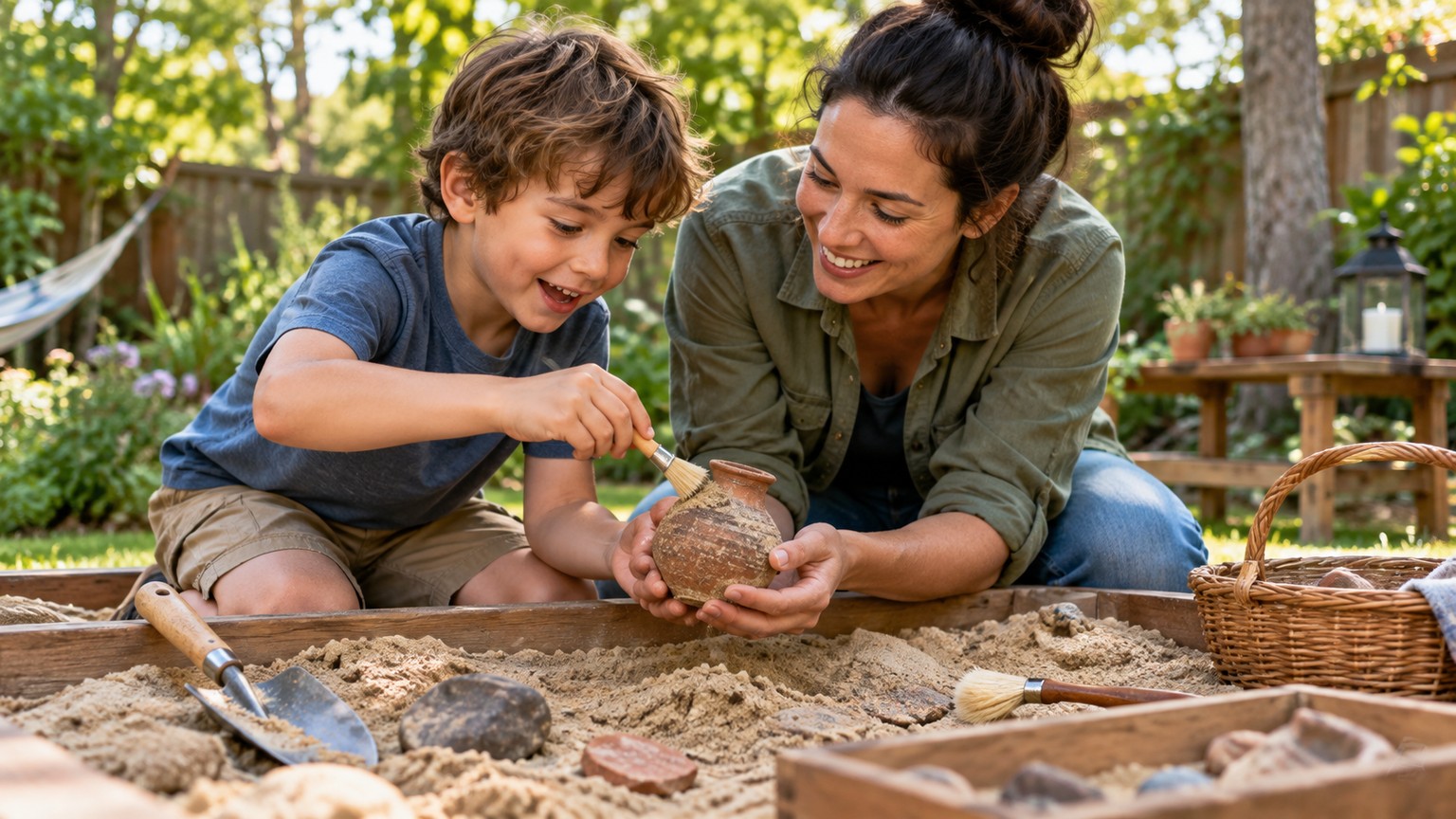
Material objects invite careful looking before explanations take over. Place a safe replica, household tool, textile, coin image, or museum photograph where a child can inspect it. Ask what it is made from, which marks came from use, what job it may have performed, and what its maker needed to know. Then identify the object accurately and compare the first ideas with trusted information. This sequence respects curiosity while teaching that an appealing guess is not the same as a supported conclusion. It also prevents artifacts from becoming exotic props. A woven basket, for example, can lead to plant knowledge, trade, labor, design, and family life when it is connected to a particular people, place, and period.
Build a Timeline Without Turning History Into a Parade of Dates
Dates matter because they establish sequence and show which events overlap, but children rarely learn well from a crowded chronology. Choose a narrow question first. A timeline about ways people sent messages might move from a hand-delivered letter to a telegraph, telephone, radio, and video call. Add only the dates needed to reveal pace and connection. Children can place one development above the line and something happening in another part of the world below it. That simple arrangement challenges the mistaken idea that only one story was unfolding at a time.
Use scale deliberately. A strip representing one child's life, a century, and several thousand years should not look identical without explanation. Try a hallway timeline, a length of string, or measured paper segments so children feel the difference. Words such as decade, century, ancient, recent, and generation become clearer when they are linked to a visible span. When exact dates are uncertain, say so. Historians often work with ranges, estimates, and competing interpretations, and children can understand that uncertainty is part of honest research rather than a failure.
Return to continuity as often as change. New inventions do not instantly erase older practices, and traditions do not remain frozen. Families may use smartphones while continuing songs, crafts, farming methods, or ceremonies with deep roots. Ask what changed, what continued, who benefited, and who encountered new difficulties. This keeps timelines from presenting progress as a smooth upward march. It also helps children recognize that people make choices within limits created by geography, resources, laws, power, and earlier decisions.
Explore Cultures Through Everyday Life
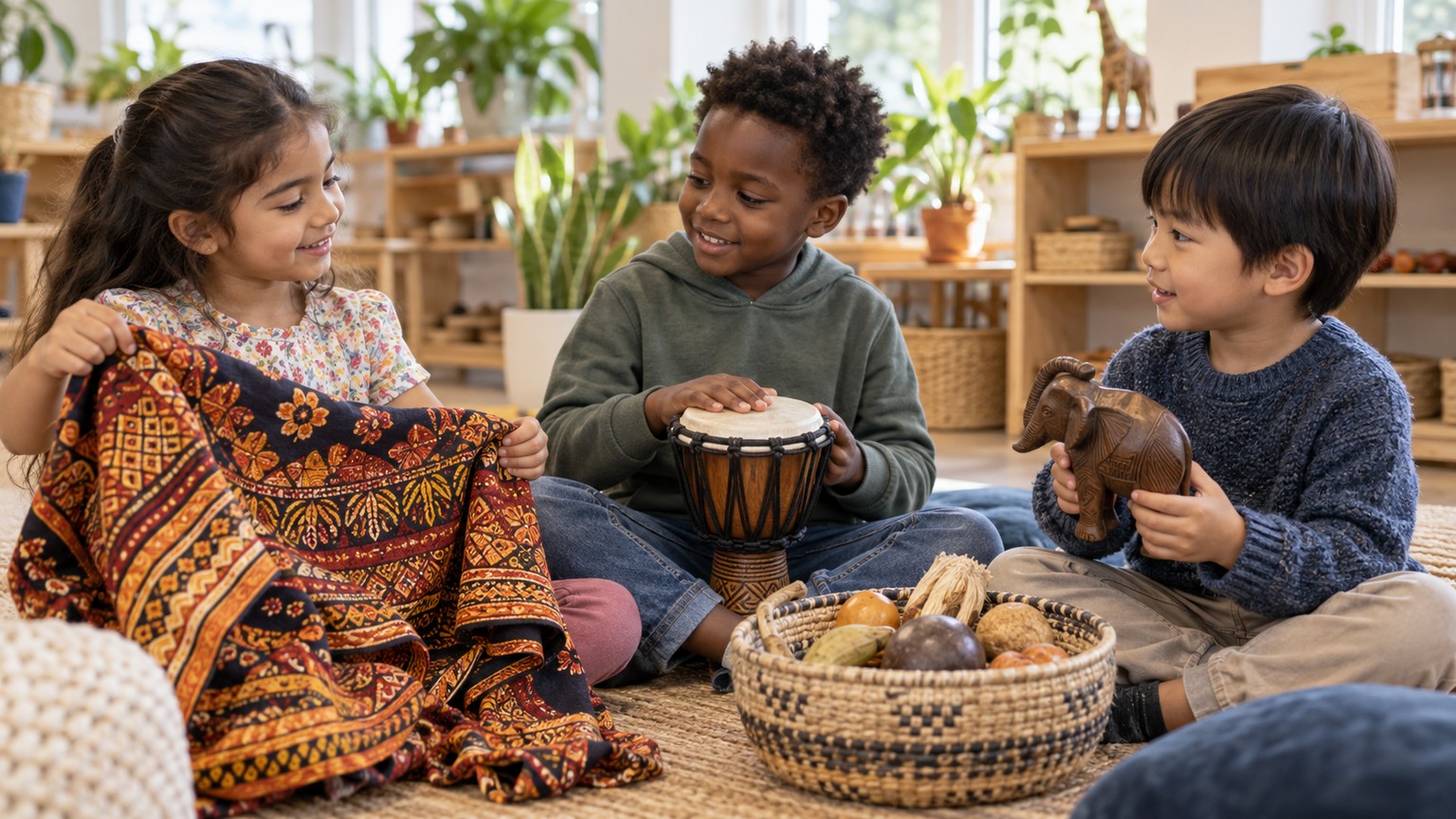
Children often meet a culture through festivals, clothing, or food. Those are engaging entrances, but they should open into a fuller room. Study how climate and local materials influence buildings, how family members share work, what children play, which languages are spoken, and how people adapt old customs in modern cities. Name the community and location instead of making sweeping claims about an entire continent or religion. Within every culture, people differ by region, generation, profession, belief, and personal taste. Phrases such as 'some families,' 'in this region,' and 'during this period' are more accurate than saying everyone follows one practice.
Use Stories While Keeping Fact and Fiction Visible
Historical fiction, legends, biographies, and folktales give children emotional access to lives unlike their own. Before reading, identify the kind of story. A folktale may carry community values without documenting a literal event; a historical novel invents scenes around researched conditions; a biography makes selections from evidence. Afterward, sort details into what the text establishes, what the author imagined, and what requires another source. This does not drain pleasure from storytelling. It lets children appreciate craft while protecting them from treating every vivid scene as fact.
Choose books created by people with close knowledge of the community being portrayed, and look beyond a single title. One story cannot represent millions of people. Pair a traditional tale with a contemporary picture book, a child-friendly interview, music, photographs of daily life, or a museum collection. If an older book contains stereotypes, decide whether the child is ready to examine them directly. Do not quietly present harmful images as neutral history. Explain who created the image, what assumption it promotes, and how people from that community have represented themselves.
Teach Difficult History With Honesty and Care
Children deserve truthful accounts of injustice, but truth should not mean graphic detail or a story built only around suffering. Explain the unfair rule or action in plain language, identify who made choices and who was affected, and include the ways people protected families, organized, resisted, created art, and pursued change. Avoid phrases that make oppression sound accidental or leaderless. Saying that a law denied a group a right is clearer than saying the right simply was not available. At the same time, do not ask children from a targeted community to speak for everyone or repeatedly encounter their heritage only through trauma.
Questions about fairness can become emotionally charged. Pause to learn what a child thinks a word means, correct misinformation without shaming, and acknowledge feelings without abandoning the facts. Young children usually need a manageable frame: people made an unfair rule; others challenged it; their actions changed some conditions; work remained. Older children can examine conflicting accounts, economic motives, propaganda, and long-term consequences. In every age group, connect the lesson to responsible action rather than guilt. Listening carefully, challenging a stereotype, protecting another person's dignity, and checking a claim before sharing it are concrete civic habits.
Be equally thoughtful when discussing war, forced migration, enslavement, colonization, or religious persecution. Preview resources, use maps that show movement without turning human lives into arrows alone, and provide moments of safety and ordinary life alongside crisis. If a child has personal or family experience with displacement or violence, coordinate with caregivers and support staff rather than assuming a group lesson is harmless. Historical empathy means trying to understand choices within past conditions; it does not require excusing cruelty or pretending every interpretation is equally supported.
Help Children Compare Sources and Perspectives
A useful source set can be small: two photographs, a diary excerpt read aloud, an object, and a modern historian's explanation. Ask who made each source, when, for whom, and for what purpose. Notice what the creator could directly know and what they might want an audience to believe. Children can circle matching details and place disagreements in a question column. Even early readers can compare facial expressions, clothing, setting, and what sits outside the frame. The habit of asking where information came from is more durable than memorizing a polished summary. Perspective is not the same as unlimited opinion. Two witnesses may remember an event differently, yet evidence can still make one claim stronger. Model language such as 'This source suggests,' 'We would need more evidence,' and 'This account leaves out.' Visit museum and library websites with children and inspect collection notes. Who donated the object? Does the label name its maker? Has the institution updated older terminology? These questions reveal that public history is created by decisions, and that labels can improve as communities contribute knowledge. Digital media requires another layer of care. Reverse-image tools and advanced research may belong to adults, but children can still check whether a page names an author, date, museum, archive, or bibliography. Compare sensational captions with the information supplied by the institution holding the image. Explain that old-looking filters, confident narration, and repeated posts do not prove authenticity. When an answer remains uncertain, preserve the question. Curiosity becomes intellectual responsibility when a child learns that 'I do not know yet' is an honest and useful position.
Create a Sustainable Rhythm for Learning
A rich history education does not require elaborate projects every week. Rotate among a read-aloud, an object investigation, a short map activity, an oral-history conversation, a recipe researched in context, and a virtual museum visit. Keep a notebook for drawings, source questions, new vocabulary, and revised ideas. Let the child occasionally choose the next path: transportation, games, medicine, homes, music, local landmarks, or migration. Choice builds ownership, while an adult's attention to source quality keeps the exploration grounded.
End each topic with synthesis rather than a quiz alone. A child might arrange three pieces of evidence and explain the story they support, record a short museum-style audio label, or draw a scene with captions identifying what is known and what is inferred. Revisit earlier conclusions when new evidence appears. Keep completed work rather than discarding it after display, because an older map or explanation gives the child something concrete to reconsider. Ask which conclusion still feels strong, which source now seems limited, and what the learner would investigate next. A monthly family history evening can sustain this habit without making it feel like school: one person brings an object or photograph, another chooses a place on the globe, and everyone contributes a question. Local libraries, cultural centers, historic sites, and community elders can extend the inquiry when approached respectfully and with advance planning. Over time, children learn that cultures are living and internally diverse, the past is connected to the present, and historical knowledge is built through careful questions. Those understandings make room for wonder without sacrificing accuracy, and for pride in one's own heritage without reducing anyone else's.
Leave the Door Open
A thoughtful investigation rarely closes every question. Keep one uncertainty visible, name the next trustworthy source, and let the child return with a new idea. That unfinished thread turns a lesson into an enduring habit of inquiry.