Make a Card, Decoration, or Memory Book for a Chosen Celebration
Browse fifty ideas for winter, spring, summer, autumn, and family occasions, then follow the worked examples for a folded tree, a translucent-paper window, a memory book, and a wide-strip pumpkin. Choose through the occasion your household observes, the available time, and the child’s intended contribution. The instructions explain the core folds, supports, display checks, and delivery needs. Use the seasonal groupings as browsing aids, adapting the subject to the family and location rather than treating the list as a required calendar.
A: They are options to choose according to the occasions and practices meaningful to the household.
A: Learn about participating families, explain the purpose, and provide equally thoughtful alternatives.
A: A shared technique can support different subjects, recipients, and meanings.
A: A chosen recipient, original image, and child-approved message connect it to a real relationship.
A: Use local observations and treat the seasonal groupings as browsing aids rather than fixed dates.
A: Use reliable context and invited community knowledge instead of treating a quick craft as the whole tradition.
A: The suggested paper forms are unlit decorations and should remain away from heat and real flames.
A: Respect that choice and find another voluntary way for them to contribute.
A: Choose with the maker; selected pieces, reusable parts, or permitted photographs may be enough.
A: Yes; crafting is one optional form of participation among the family's other meaningful activities.
Let Family Meaning Guide the Project
Ask which celebration the child wants to prepare for and what they associate with it. They may remember a shared meal, a person who visits, a favorite story, or a decoration that returns each year. Use that connection as a starting point. The craft can express a personal memory instead of copying the same commercial symbol on every child’s page.
Families celebrate different occasions in different ways, and some do not observe particular holidays at all. Offer a genuine alternative in a group setting without requiring a child to explain private beliefs. The NAEYC collection on purposeful holiday experiences offers resources for thoughtful, inclusive planning. Keep invitations connected to the actual families present rather than assuming one household’s practice represents everyone.
Choose a Project That Fits the Available Time
Count preparation, making, drying, and cleanup before selecting the craft. A broad flat greeting can be completed in one short session, while painted raised pieces need time before assembly. Check when the gathering happens and where wet or unfinished work can stay. Choose the core contribution first: a standing tree, a readable message, or a few book pages. Extra decoration can follow only when the main feature is ready. Tell the child which part can be used today and what needs another visit, so the finish matches the actual materials and time available.
Make a Folded Tree, Winter Window, or New Year Book
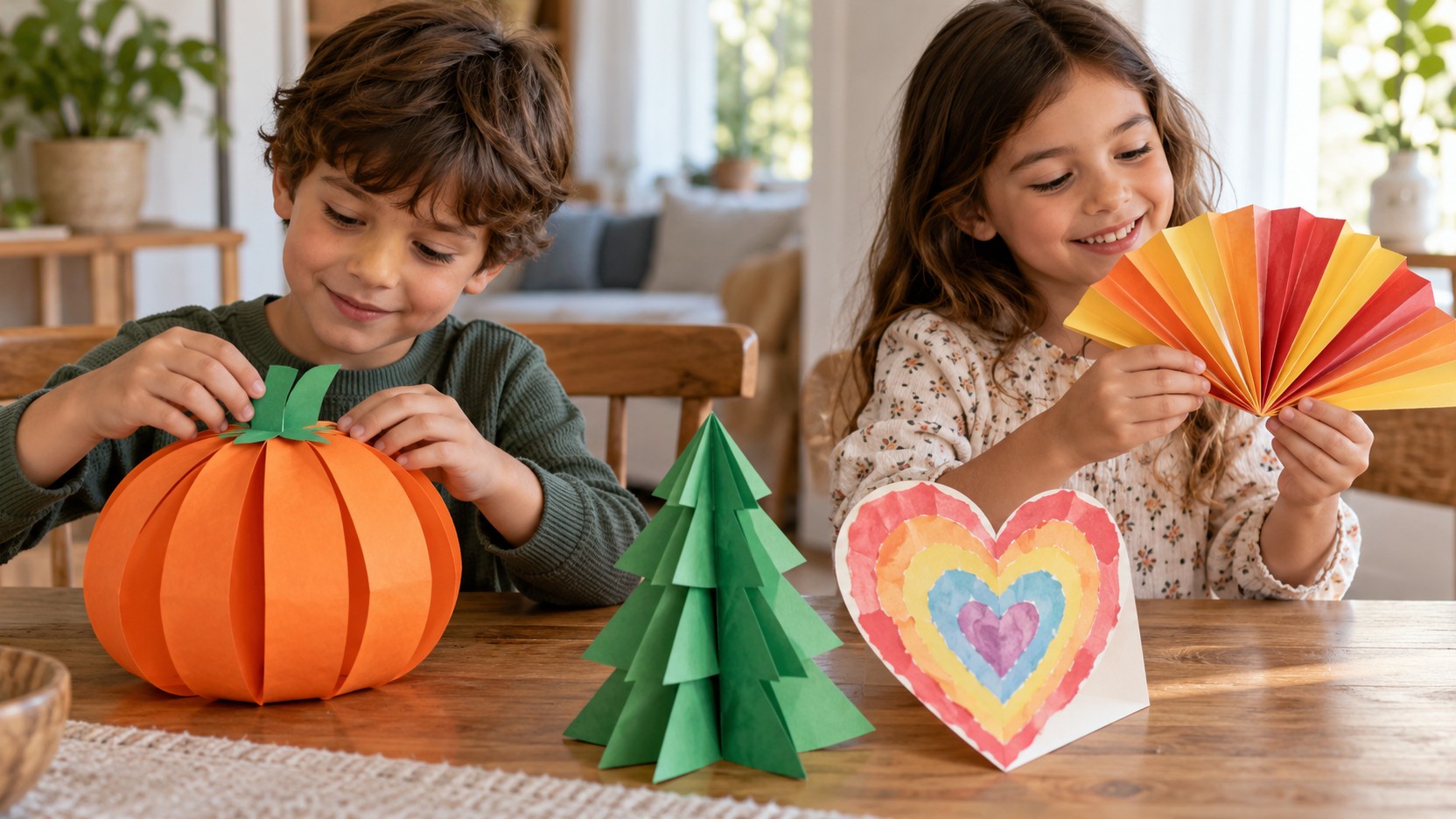
Folded tree: choose sturdy green or other child-selected paper, a broad card base, and familiar drawing tools. Fold a sheet in half and let an adult prepare a simple tree outline where cutting requires help. Open it, decorate the large surfaces, and use broad folded tabs to attach it to a low base. Test whether it stands before adding more weight. In a household celebrating Christmas, the child can connect its decorations to that occasion; in another setting, choose and describe the subject accurately.
Winter window: use a broad adult-prepared card frame and suitable translucent papers. Arrange large pieces inside the opening, overlapping two colors where the child wants a new effect. Attach with an appropriate method and keep the design flat enough for a safe adult-managed display. Compare its appearance against ordinary window light without looking at the sun. A snowy view is optional; a night garden or a locally familiar winter scene can provide the subject.
New Year memory book: fold a light stack of broad sheets into a small booklet and choose three moments the child wants to remember. Give each moment a picture page and test the order by turning the actual pages. An adult uses a suitable assembly method for the materials and intended reader, checking that pages stay secure and open freely. Leave the last inside page for a chosen future idea, and keep important images clear of the fold. Add dictated wording only if wanted, with the maker approving the language. Read the book with its chosen audience or keep it as a personal record.
Use Cards to Communicate Something Specific
A greeting card becomes more personal when it has a chosen recipient and purpose. Ask what the child wants the person to know. A drawing of a shared place, an invented joke, or a carefully chosen color arrangement can carry that message. An adult may scribe dictated words faithfully if the child wants text. The maker should approve the message rather than receive an upgraded adult version at the end.
Keep the construction compatible with the delivery method. Raised pieces may need a box instead of an envelope, while a broad flat image travels more easily. Test whether the card still closes before adding further layers. A simple pop-open shape can introduce a mechanism without making the whole project depend on precise small cuts. Prepare difficult steps as an adult and leave design decisions with the child.
Let Spring Projects Follow Local Observation
Spring-themed crafts can respond to what the child actually sees rather than an assumed climate. Buds, rain, new leaves, or another local change may provide a subject. A paper flower, painted garden picture, or patterned egg shape can fit a particular family celebration when that connection is chosen intentionally. Explain the occasion accurately instead of treating seasonal imagery as the complete meaning of a religious or cultural holiday.
A thank-you project for a caregiver should let the child choose the person and relationship. Families have different structures, and not every child wants a craft assigned to the same adult role. A small portrait, memory card, or folded flower can be directed to someone meaningful. Keep participation voluntary when an occasion brings difficult feelings.
For Earth Day or another environmental event, connect the craft to a practical material choice. Use available broad scraps for a planet picture or create a temporary arrangement that can be dismantled. Avoid claiming that a heavily mixed decoration is automatically environmentally ideal. Discuss the particular decision the child made, such as using an existing supply or preserving parts for another activity.
Make Summer Gatherings Personal Without Adding Much Waste
A family picnic, community event, or birthday can use a child-created display rather than many disposable decorations. A broad folded fan, a picture welcome sign, or a reusable celebration panel gives the maker a visible role. Keep art materials away from direct food contact, and place displays so they do not obstruct movement or access. The project should serve the gathering without creating a new handling problem.
Let children decide which part can be used again. A plain backing can hold a new picture for another event, while removable shapes can change with the occasion. If a date or greeting is included, place it on a replaceable panel. Reuse works more easily when it is considered before permanent attachment. A flexible decoration can preserve a favorite technique while giving each celebration its own details.
Make a Wide-Strip Pumpkin for a Chosen Autumn Occasion
Gather broad paper strips, a sturdy base, and suitable adhesive. An adult prepares difficult cuts. Arrange the strips as a loose curved pumpkin outline on the base, attach one end of each, and test the remaining curve before fixing the other ends. Keep the form low and manageable rather than forcing a tight shape. Add a broad drawn or paper stem after the structure works. For a family choosing Halloween, a large flat face can give it a character; for another autumn gathering, leave the color and shape as the focus. Use the same technique with locally meaningful subjects where the season differs.
Learn About Unfamiliar Traditions Before Borrowing Their Symbols
Begin with reliable material and, where invited, the experiences of people who observe the occasion. A craft is only one small part of learning about a holiday. Avoid presenting a quick decoration as a complete explanation of a community’s beliefs or practices. Families within the same broad tradition may differ, so a single example should not become a universal claim.
For example, the Smithsonian National Museum of Asian Art’s Lunar New Year resources can support further learning. Choose an activity in context rather than combining unrelated symbols because they look festive. If a family shares a practice, ask how they want it represented and whether an art activity is appropriate.
Leave room for respectful observation instead of compulsory celebration. A child can learn that another family’s occasion matters without being expected to adopt its religious actions. In group settings, explain the purpose of the activity and provide an alternative with equal care. The goal is a more accurate understanding of people, supported by creativity rather than replaced by a craft.
Set Up a Shared Table With Independent Choices
Use one common technique to organize the supply without requiring the same picture. For a folded-card table, prepare suitable backing, broad paper pieces, drawing tools, and the joining method needed. One maker can create a tree, another a landscape, and another a greeting. Give each a work area with enough space to open the card and test any standing part.
Prepare difficult cuts as an adult and leave a matching spare piece for fold or attachment trials. Test the largest raised part before using smaller decorations around it. Put a drying tray away from hands reaching for common supplies, and agree before joining two makers’ work. This setup keeps the next making action clear while each contribution has its own subject or recipient.
Check a Gift’s Message, Closure, and Delivery
Choose the recipient and the message with the maker, then check how the finished piece will travel. Place a flat card beside its envelope before adding raised parts, or use a suitable shallow box for a small construction. Close and reopen the greeting to see whether a decoration catches at the fold. An adult can record an approved dictated message and read it back before attachment. Ask whether the maker wants to give this version away or keep it and make another. Pack the work only when joins and painted areas are ready for handling.
Plan Display and Storage Before the Table Fills
Choose a safe display place and a reasonable duration. Keep paper away from heat and real flames, avoid obstructing walkways, and have an adult handle any appropriate hanging method. Some decorations can remain tabletop pieces, reducing the need for cords or attachments. Let the maker help decide which orientation shows the work best.
After the occasion, discuss what to keep, dismantle, reuse, or discard according to local guidance. A few meaningful pieces can be stored flat, while a photograph taken with permission may preserve a bulky arrangement. Avoid assuming that every holiday craft must become a permanent keepsake. A clear ending makes seasonal making more sustainable for the household.
Use the Fifty Ideas as a Flexible Year-Round Menu
The first collection offers winter and New Year possibilities, the second spring and greeting projects, the third summer gathering ideas, and the fourth autumn invitations. The final collection can adapt to birthdays, family milestones, and other chosen celebrations. Seasons differ by location and hemisphere, so use the groupings as browsing aids rather than fixed dates.
Choose an idea according to meaning, materials, and the child’s desired action. A maker interested in folding may prefer a fan or stand, while someone who enjoys storytelling may choose a memory book. Keep one unfamiliar technique at a time when that helps. The project can be simple and still be original because the child chooses its subject and intended effect.
Repeating a technique across the year can be useful. The same broad card fold might support several different messages, with new images and recipients providing a fresh purpose. Repetition does not require identical products. Familiar construction gives children more attention for the meaning they want the next piece to carry.
Keep the Celebration Larger Than the Craft
A project can contribute to a gathering without becoming its central obligation. Leave time for conversation, play, rest, and the practices the family actually values. If a child chooses not to make something, they can still belong fully in the occasion. Thoughtful holiday crafting offers an accessible way to participate, share a memory, or communicate care. Its value comes from the connection between the maker, the work, and the people involved, rather than a table full of matching decorations.