Start With Mirror Dance, a Movement Chain, or One Clear Cue
Choose a dance game through its shared rule: follow a partner, respond to a visible cue, add an action, or explore an imagined place. The complete rounds below explain Mirror Dance, Freeze Dance, Movement Chain, Dance Postcards, and conductor and pathway games. Use the setting table to select a starting format, then demonstrate one short round before adding music or another rule. Keep movement comfortable, check the space, and provide a clear way to watch, join, change roles, or pause.
A: A shared rule gives participants something specific to notice, decide, or coordinate.
A: Yes; use missed cues as a reason for a calm restart and clearer information.
A: Offer simultaneous group movement, paired options, and voluntary observing roles.
A: Keep only as many as the group can recall comfortably while still enjoying the dance.
A: Participants can share direction, timing, or shape while interpreting movement accessibly.
A: Use small circles, parallel pairs, or simultaneous stationary responses.
A: It is a clear imagined place or situation that invites an original short movement response.
A: Separate predictable routes can provide an engaging challenge without crossing traffic.
A: Yes; visual cues, internal timing, and shared observation can organize a complete round.
A: Simplify one feature, demonstrate again, or end if the group needs a break.
Choose the Group Rule Before Choosing the Playlist
Decide what will make the activity a game. A shared stop cue, a change of leader, or a pattern to remember gives participants a clear task beyond moving whenever music plays. Select one rule and demonstrate how a round begins and ends. Then choose music or a live sound that supports that rule at a comfortable volume. A busy recording is not always the easiest starting point. Silence can also support a mirroring game or a movement sequence when listening to a track would add unnecessary complexity.
Prepare for the Setting You Have
At home, clear the planned space of breakables and slipping or tripping hazards. Keep a pair’s gestures inside the room available and show where the game begins and ends. Mirror Dance can use hands or arms without traveling. A small room therefore needs a clear personal area rather than an improvised obstacle course.
For a classroom, test whether the leader’s cue can be seen from every place. Use pairs or smaller circles if one large line would leave most children waiting. Explain how roles exchange and where an observer can watch. Prepare the next transition so a finished pair knows what happens after its round.
At a party, begin with a shared response rather than a surprise solo. Demonstrate the single rule, keep sound comfortable, and choose a format that works with the actual numbers. Try the stop cue with the whole group once before the first moving round, so each participant sees how the activity returns to its starting position. Confirm any relevant access arrangements before starting. A short first round lets the host see whether spacing, cues, and the chosen role structure need changing.
| Setting | Starting format | Check before playing |
|---|---|---|
| Two people at home | Slow Mirror Dance with a role exchange | Comfortable distance and clear arm space |
| A classroom group | Parallel pairs or a visible conductor cue | Everyone can see and waiting stays manageable |
| Mixed party group | Simultaneous personal-space responses | One rule, suitable sound, and an understood finish |
| A clear larger area | One predictable pathway at a time | Route, boundary, and waiting place stay separate |
Try Mirror Dance With a Predictable Lead
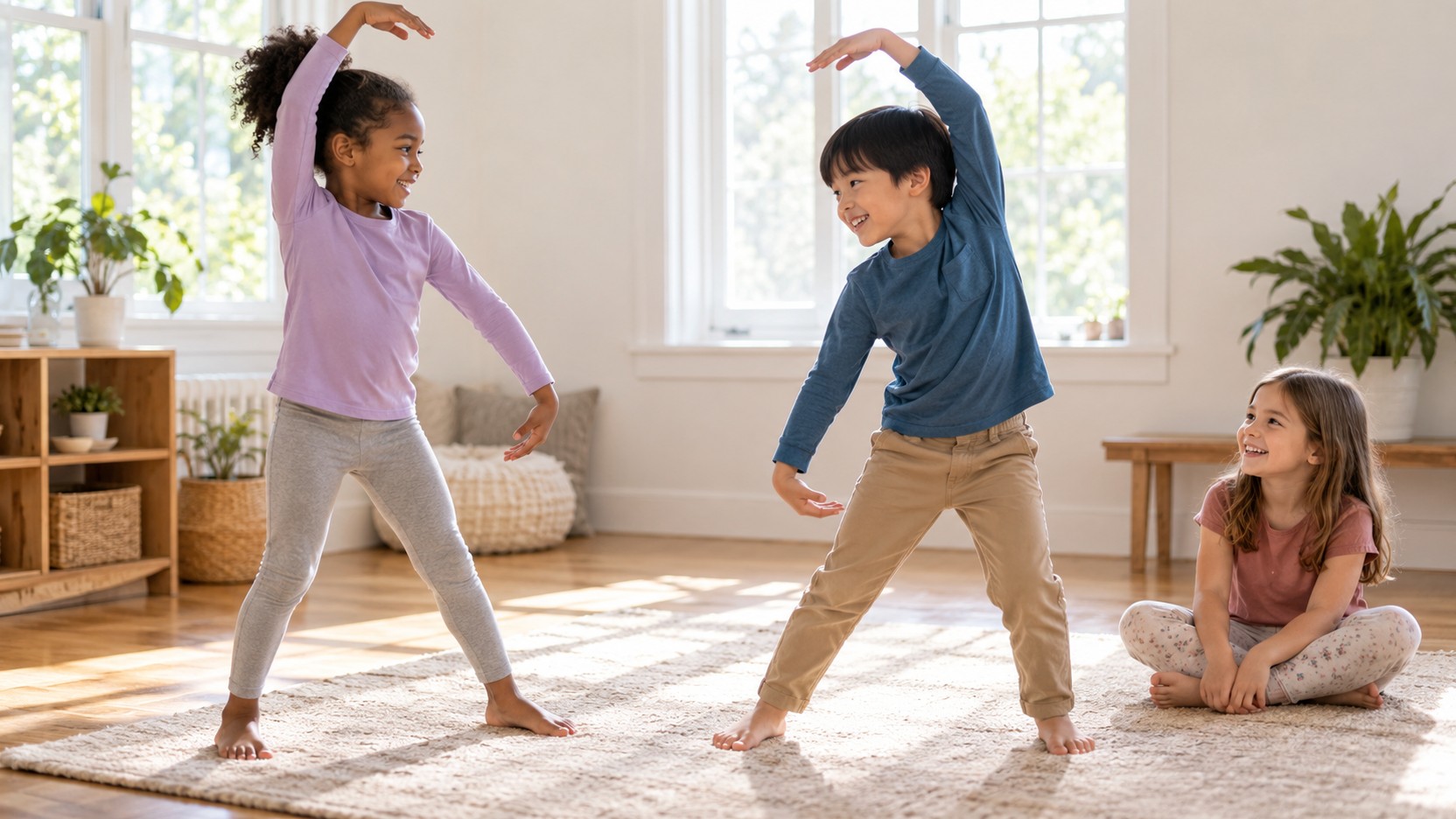
Partners face one another at a comfortable distance. One person makes slow manageable movements while the other follows the overall direction and shape. Begin with arms or hands before adding steps. Agree on a clear cue for changing roles and keep the pace gentle enough that the follower can respond without rushing. A seated participant can mirror the same intention through a smaller range. The game is about paying attention to another person’s choices, not proving that two bodies can form identical shapes.
Use Freeze Dance as a Shared Listening Game
Explain that everyone moves comfortably while the music plays and returns to a stable ordinary position at the stop cue. Demonstrate the cue before beginning and add a visible signal when helpful. Avoid demanding a difficult frozen balance. The group can choose a theme for the moving section, such as smooth shapes or small traveling steps, while keeping the stopping action simple.
Restart calmly when someone misses the cue. They remain in the game and can try again with clearer information. Let a willing child control the visible signal or choose the next movement theme. If the recording’s sudden silence is uncomfortable, use a gentler live cue instead. The useful challenge is noticing a change and coordinating a response, and that does not require catching anyone out.
Build a Movement Chain One Contribution at a Time
One participant chooses a familiar comfortable action. The next repeats it and adds another, creating a short shared phrase. Keep the chain small enough to remember, and stop adding when the group wants to repeat what already exists. A long chain can turn the game into a memory test that overwhelms the dancing. The host can act as a quiet visual reminder without taking over the choices.
For a mixed group, allow each action to have more than one physical interpretation. A broad standing reach might become a seated arm curve, while a traveling step might be represented by a hand pathway. Agree on the feature being shared, such as direction or timing. That keeps the chain recognizable while allowing bodies and access needs to differ.
After trying the phrase, let the group decide one revision. They might repeat a favorite action, place a pause between two contributions, or reverse a short section. Keep the contributors involved in changes to their ideas. A collaborative phrase becomes more meaningful when children hear that their decision remains part of the group’s work rather than disappearing into an adult-arranged routine.
Play Dance Postcards With Clear Imagined Places
Offer a place or situation rather than a prescribed pose: a quiet moonlit garden, a busy imaginary workshop, or a boat moving through gentle water. Each person creates a short movement response and chooses whether to share it. Keep the prompt broad enough for different interpretations but concrete enough to begin. Avoid using a culture or country as a shortcut for a stereotyped dance.
Participants can show their responses simultaneously within personal space, in pairs, or one at a time by choice. Invite observers to describe what they noticed without guessing at private meanings or ranking performers. A child might explain that a small repeated action represents a machine, while another uses a smooth curve for the same setting. The different solutions are part of the game’s interest.
Let a Conductor Change One Movement Feature
Agree on two or three visible cues before starting. An open hand might invite a larger action within comfortable range, while a smaller gesture invites a compact version. Another cue can mean pause. Practice the cues without music, then let a leader combine them during a short round. Keep the movement itself familiar so attention can go to the signal. Change leaders voluntarily and avoid adding so many cues that the game becomes a confusing code.
Create Pathway Dance Without Crossing Traffic
Choose one clear route through the space, such as a broad curve from one boundary to another. Let a small number travel while others make stationary gestures or observe. Keep everyone moving in a predictable direction, with a clear place to wait outside the route. The leader can change the story or the movement quality without making the path faster or more hazardous.
A second route should be added only when the space and participants can manage it comfortably. Intersecting paths are unnecessary for an engaging game. Children can compare a straight route with a curved one in separate rounds, or invent a hand pathway while staying in place. The artistic choice concerns how movement uses space, not how narrowly players can avoid one another.
Ask travelers what they noticed after a trial. A turning point may be too close to a wall, or the waiting area may block the exit. Revise the setup in response. A host who adjusts the environment gives the group a more useful solution than repeatedly warning everyone to be careful. Let children contribute a safe route change when they have a clear idea.
Offer the Entry Role Before Starting the Round
Explain the available entry roles alongside the demonstration. For Mirror Dance, a child can follow beside a familiar partner, lead a slow phrase, or watch the opening exchange. For Dance Postcards, participants can respond simultaneously within personal space instead of presenting alone. Ask which format fits, and keep the shared rule clear across the choices.
Check before photographing, recording, or sharing the activity. When discussing a round, refer to the chosen pathway, pause, or cue that the maker wants to explore. A concrete observation such as “your pause showed when the partner could begin” connects feedback to the game. Keep personal or private interpretations with the participant rather than assuming that an invented movement reveals them.
Prepare a Reusable Host Plan for the Next Group
Keep a brief host plan beside the equipment: game name, one rule, opening cue, role change, and ending. For Mirror Dance, that could be slow arm shapes, a willing leader, an announced exchange, and resting arms to finish. Put the practical spacing and any agreed access arrangement on the same reminder. Use it before the group arrives so the rule can be demonstrated in one clear round. The plan supports the host while leaving children’s movement choices open.
Prepare two possible versions for a setting with uncertain attendance. A small party can play in pairs, while a larger group may need simultaneous personal-space responses. Decide in advance which features change and which rule remains constant. Test music controls and volume before guests arrive if a recording is part of the plan. A simple activity becomes easier to host when equipment and room arrangement do not demand attention during the first explanation.
Afterward, ask whether the chosen format gave everyone a workable entry. Notice who waited too long, whether cues were visible, and which parts children asked to repeat. Use that information to revise the host plan. A game can remain familiar while the setup becomes more responsive to a particular classroom, household, or gathering. That practical refinement often matters more than introducing an entirely new theme at every event.
Change the Rule When the Game Becomes Confusing
Look for the point where participation breaks down. A cue may be too subtle, the chain may be too long, or the music may hide verbal instructions. Simplify one feature and demonstrate a fresh short round. Avoid adding more rules in response to confusion. If the group is tired or uncomfortable, finish instead. A clear ending preserves a game as something worth returning to rather than a challenge everyone must endure until the host decides it counts.
End With a Shared Choice About What Comes Back
Announce the final round and give the group an ending they can recognize. That might be a collective ordinary stillness, a final familiar gesture, or a conductor’s closing cue. Allow time to return to the next routine without rushing from lively movement into another demand. Check that props and equipment are put away where they will not become hazards for the next activity.
Ask which rule was most enjoyable and which variation would be worth trying later. Children may prefer the relationship of mirroring, the invention of a postcard, or the teamwork of a chain. Save the practical details that made that version work, including spacing and accessible options. A few understood favorites can serve home, school, and parties better than a long list of games whose instructions nobody remembers.